Where's the cheapest place to refuel a yacht in the Adriatic?
Montenegro. The saving is large enough to change where superyachts spend the season, and the national yacht register now shows what I've been watching from the ground in Tivat: more of these boats are staying.
The arbitrage, in numbers
Since 2025, Montenegro has reinstated tax and duty-free diesel for all foreign-flagged yachts, private and commercial. I size the saving against Montenegro's own duty-paid pump price, which the Ministry of Energy regulates at roughly €1.65-€1.79 per litre. Duty-free strips out the Montenegrin excise (around €0.33-€0.44 per litre) and 21% VAT. I don't quote a saving against Croatia, Italy or Greece, because each applies its own excise and its own VAT (25%, 22%, 24%), so that comparison has to be run on the destination country's rates. A superyacht burning 500 litres an hour saves €50,000 to €100,000 over a single Adriatic season.
The rules are short. Montenegro's 15% reduced VAT rate covers marina services, not fuel. Foreign flag only. There is no minimum stay since the 72-hour requirement was lifted in September 2025. Three licensed marinas sell it: Porto Montenegro in Tivat, D-Marin Portonovi in Herceg Novi, and Marina Bar. After bunkering the vessel must leave Montenegrin waters, but it can return immediately, and everything runs through a licensed yacht agent. The legal basis is the Customs Law and the Ministry of Finance regulation on the reception of foreign vessels, and it holds only until Montenegro joins the EU.
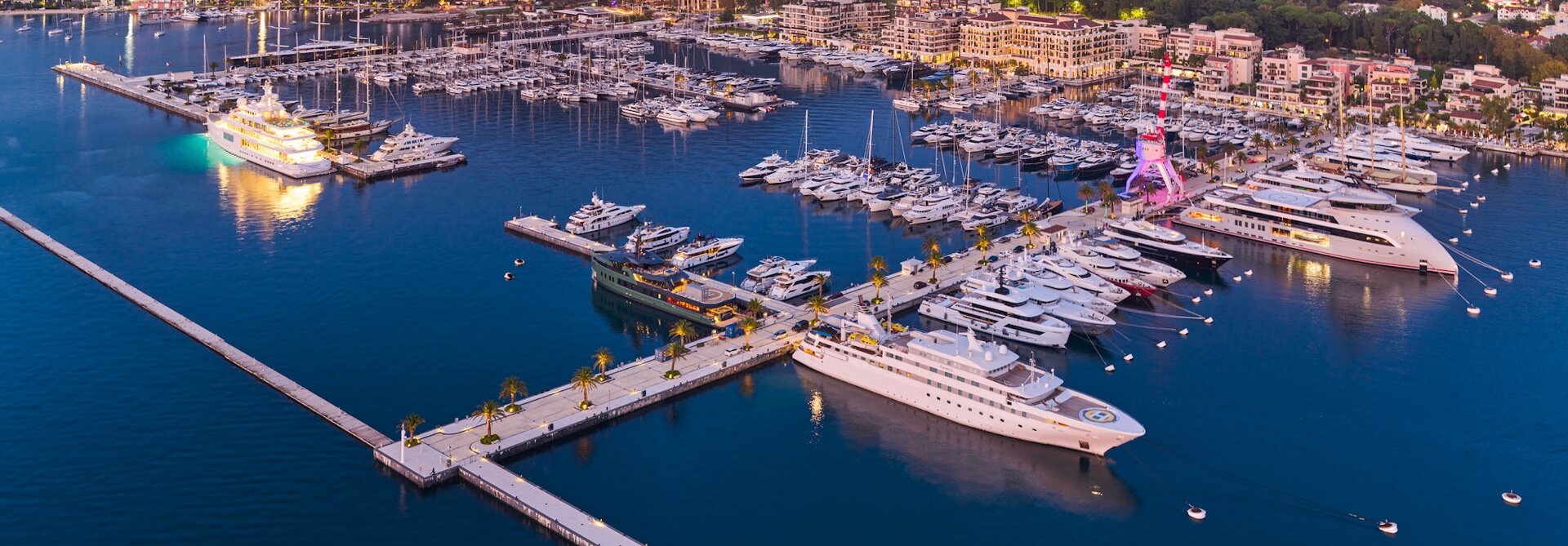
Porto Montenegro is why this scales. Its fuel dock takes yachts up to 200 metres, holds around 800,000 litres in stock, pumps up to 1,000 litres per minute, and takes advance bookings for orders above 100,000 litres. The marina has run at 100% berth occupancy below 35 metres for three years straight, and a 100-berth expansion is scheduled to begin in 2027.
The register is the tell
Montenegro's national yacht register grew from 482 vessels in December 2024 to 525 in December 2025, 9% in a year. In 2024, 4,693 foreign leisure vessels arrived carrying 22,774 people. The industry quotes the percentage and hopes you don't ask about the base, so here it is: 9% is 43 boats. That's small. But a register entry is a different thing from a fuel call. A bunkering yacht has to leave Montenegrin waters the same day, while a registered one has made this coast its legal home. In my experience, 43 new long-term addresses on the water show up as demand on land 12 to 24 months later.
Why a captain's decision becomes a property decision
Captains route on cost and infrastructure. Owners spend two to four weeks aboard each season, usually the same weeks, the same berth, the same waterfront. In year two, they extend. In year three, they ask what the apartment above the marina costs. That's the path that built the residential market around Porto Montenegro over the past decade, and it is now extending into Luštica Bay and Portonovi. In my experience residential transactions follow yacht traffic with that 12-24 month lag. Disclosure: I sell new-build around the Bay of Kotor, so I have a position in exactly the buildings this demand lands in. Weigh my read accordingly.
Three other frictions are falling at the same time. British Airways opened Heathrow-Tivat in May 2026, Wizz Air's Podgorica base added 17 European routes, and Aman Sveti Stefan is reopening. Each turns a bit more seasonal traffic into year-round presence. Meanwhile the diesel advantage expires on EU accession, and Montenegro is on track to close its negotiation chapters in 2026. The marinas are full now, and the buildings around them have a known supply ceiling.
What I'd watch
The December 2026 register print and whether 525 keeps its 9% pace, the start of the 100-berth expansion in 2027, and the accession timeline that closes the duty-free fuel window.
Last verified: 10 August 2026, against the Customs Law, the Law on Excise and the Ministry of Energy's regulated fuel price.