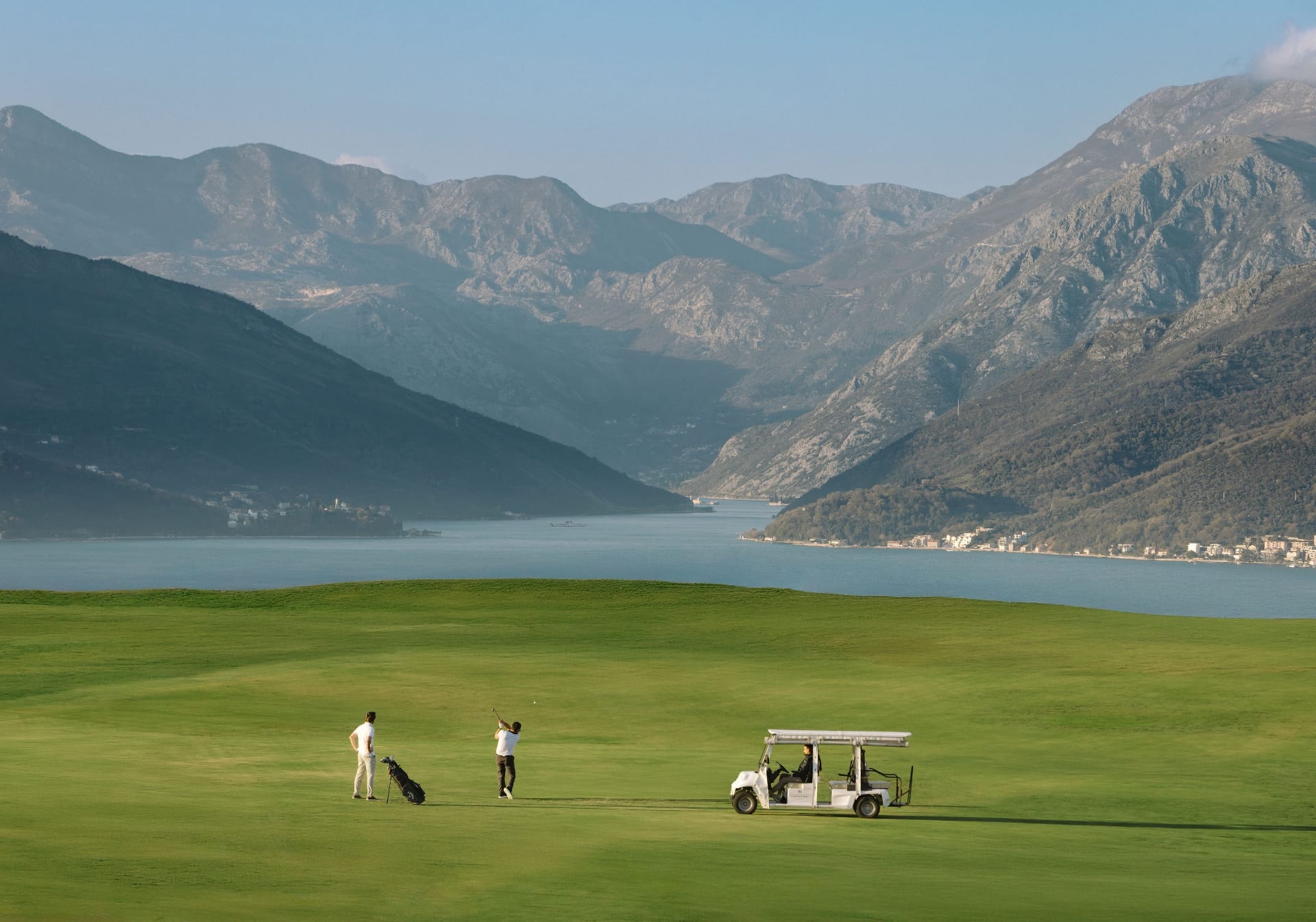
A US citizen can buy an apartment, house or building land in Montenegro in their own name. Americans can stay 90 days in any 180 without a visa. Owning a home is a legal ground for a temporary residence permit, valid for up to one year and renewable, once the property is registered in your name and worth at least €150,000. The permit is meant for people who live here, and it can be cancelled if you spend more than 30 days outside Montenegro. Buying new from a developer means no transfer tax. There is no tax treaty between the US and Montenegro. (Checked 25 September 2026.)
Who this guide is for
Most of the Americans who contact me have a tie to this part of the Mediterranean. Some have family roots in the former Yugoslavia. Many are retired, or have sold a business in the US or are about to. This guide answers the questions they ask me first.
At a glance
| Question | Answer for a US citizen |
|---|---|
| Can I own property? | Yes, apartments, houses and building land, in your own name. Agricultural and forest land, islands and land within 1 km of the land border are restricted |
| Visa-free stay | 90 days in any 180 |
| Residency through property | Yes, a permit for up to one year, renewable. The property must be registered in your name and worth at least €150,000 |
| Can an off-plan contract get me residency? | No. You apply once the unit is built and registered in your name in the cadastre |
| Time abroad on a permit | More than 30 days outside Montenegro can cancel the permit |
| Purchase costs, new build | No transfer tax. VAT is paid by the developer and is usually in the price |
| Purchase costs, resale | Transfer tax 3% to 6%, progressive, paid by the buyer |
| Capital gains tax | 15% of the net gain |
| US-Montenegro tax treaty | None |
Two ways to spend time here
Before you think about residency, decide how many months a year you will spend here. That decides which rule suits you.
If you will split the year between Montenegro and the US, use the 90-day rule. A US passport gives you 90 days in any 180 days, with nothing to apply for. In practice that is about three months here, three months away, then back again. April to June here and October to December here is roughly six months a year in Montenegro without a permit. Your stay has to be registered with the police within 24 hours of arrival. Hotels do this for you; in your own home you do it yourself.
If you will live here most of the year, apply for a residence permit. The permit lets you stay all year. It can be cancelled if you spend more than 30 days outside Montenegro. Until January 2026 you could be away up to 90 days if you told the police first, but that exception has been removed. A buyer who spends two winter months in the US should not rely on a permit.
Residency through property
Owning a home is one of the legal grounds for temporary residence, on the following conditions.
- The property has to be registered in your name. You need the cadastre title sheet (list nepokretnosti) showing that you own the property, or at least half of it. An off-plan contract is not proof of ownership. It has to be a house, villa, apartment or other building. Land alone does not qualify.
- The value has to be at least €150,000. This rule applies to Americans since 17 January 2026. Citizens of EU countries, Iceland, Liechtenstein, Norway and Switzerland, and family members of EU citizens, are exempt.
- How the value is proven. On a resale, the proof is the transfer-tax decision issued by the municipality, and its taxable base must be at least €150,000. A new build bought from a developer pays VAT instead of transfer tax, so it never gets a transfer-tax decision. When the unit is finished, paid in full and registered in your name, you receive your first annual tax decision. That is when you apply. For a new build, I use the first annual tax decision as the proof of value, since new builds never receive a transfer-tax decision. I confirm its acceptance with MUP for each client before the application is filed.
- Fingerprints and photo are taken in person. The purchase itself can be done remotely through a power of attorney. Since 2026 the law also allows the residence application to be filed online, but you then have 10 days from arriving in Montenegro to give your photo, fingerprints and signature at the MUP office where you live.
You also need health insurance (travel health insurance from an authorised insurer is accepted) and means of support of at least €20 for each day of the stay you apply for.
The permit is valid for up to one year. You renew it in person between 60 and 30 days before it expires, on the same ground, with proof that your taxes were paid while the permit ran. Your spouse, your children under 18 and a same-sex life partner can join you through family reunification, and they do not need their own property. The permit does not give you the right to work in Montenegro.
Permanent residency
After five years of continuous residence on a temporary permit you can apply for permanent residence, as long as your temporary permit is still valid on the day you apply. Under the current Law on Foreigners, time on any temporary permit counts, including one based on property. You may read older guidance, including an out-of-date English page on the government website, saying property years do not count. That rule belonged to the law repealed in 2018. Confirm with MUP when you apply.
The other conditions are steady means of support, health insurance, accommodation, proof that you paid your taxes during temporary residence, and basic Montenegrin, which is tested. Applicants under 14 or over 65, and citizens of former Yugoslav republics, do not take the language test.
The law allows absences of up to ten months in total, or six months at once, over the five years. The 30-day rule on the temporary permit still applies throughout, so plan your five years around it.
Sources: Law on Foreigners, Arts. 43, 44, 56, 61b, 63-65, 86 and 88, as amended by Sl. list CG 3/2026 (in force 17 January 2026) - Official Gazette. Visa-free stay - Decree on the visa regime and US State Department.
What buying costs
Buying new from a developer is the cheaper route by a wide margin. The contract is the developer's standard one, and there is no transfer tax, because the developer charges VAT instead. VAT is usually included in the quoted price. Notary fees are small, and in my deals the extra costs on a new build come to under 0.5% of the price.
You do not need your own lawyer when you buy from an established developer with a proven record, like every development listed on anapajkovic.com. Their contracts are standard and their approvals are documented. If you buy new from a small local developer, you need a lawyer, without exception.
On a resale the buyer pays transfer tax: 3% up to €150,000, 5% on the part between €150,000 and €500,000, and 6% on the part above €500,000. A lawyer is worth having on a resale, because the title and permits of an older property need checking. My transfer tax calculator works out the tax on any price.
Full line-by-line costs are in my guide to buying property in Montenegro.
Source: Law on Real Estate Transfer Tax, Arts. 6, 7 and 11 - Government of Montenegro.
Taxes an American should know
- No tax treaty. Montenegro has no double taxation treaty with the United States. US citizens are taxed by the US on worldwide income.
- Capital gains on a sale in Montenegro are taxed at 15% of the net gain. The purchase price is adjusted for inflation. The exemption for a sole main home applies only if it was your registered domicile in Montenegro, which a holiday home usually is not.
- Rental income is taxed at 15% of rent minus costs. If you do not document your costs, a standard deduction applies: 30% in general, 50% for tourist lets where tourist tax is paid, and 70% with a travel agency or tourist organisation contract and at least 60 days' occupancy a year. That puts the effective rate on gross rent between 4.5% and 10.5%.
Speak to a US tax adviser before you buy. I advise on the Montenegrin side only.
Sources: IRS list of US tax treaties; Law on Personal Income Tax as amended by Sl. list CG 160/25 - Government of Montenegro.
Healthcare
Public health insurance through the national fund is tied to employment or permanent residence, so owners on a property permit plan on private insurance and use both public and private care.
Public:
- Tivat Health Centre (JZU Dom zdravlja Tivat), Istarska street, central Tivat: GP, paediatrics, gynaecology, laboratory, X-ray and ultrasound. Open 07:00-21:00 on weekdays and 07:00-14:00 at weekends. Its Radovići clinic is the nearest public GP to Luštica.
- Emergency Medical Service, Tivat unit: 24-hour emergency care. Dial 124.
- Clinical Hospital Centre Kotor (KBC Kotor): the nearest hospital to Tivat, with an emergency block, surgery, internal medicine including cardiology, gynaecology and obstetrics with a maternity ward, paediatrics and neurology.
- Clinical Centre of Montenegro, Podgorica: the country's main hospital for serious cases.
- Vaso Ćuković Special Hospital, Risan: orthopaedics, neurosurgery, neurology, plastic surgery and rehabilitation.
Private:
- Milmedika, Porto Montenegro: a polyclinic opened in 2024 at the entrance to the development, open daily 08:00-20:00, with specialists, a laboratory, radiology, surgery, paediatrics and home visits.
- LB Medical, Luštica Bay: the resort's own clinic, open around the clock, with a doctor, a medical technician and an ambulance.
- CODRA Hospital, Podgorica: private hospital with surgery across most specialties, a maternity ward and PET-CT.
Where to live
The three developments I show American buyers are all around Tivat, close to the airport and to Tivat's healthcare.
- Porto Montenegro, Tivat. Full-time life around the marina: restaurants, cafés, children around all year. Milmedika's clinic is at the entrance to the development and the Tivat health centre is in the town centre.
- Boka Verde, Tivat. A car-free development with all parking underground. Everyday care is in Tivat.
- Luštica Bay, on the Luštica peninsula near Tivat. A self-contained resort with its own clinic and ambulance, a marina, and golf at The Peaks. The nearest hospital is in Kotor.
If you have children, my schooling in Montenegro guide covers the international schools and how the school run shapes where to buy.
Tell me what your year looks like: how many months here, family visiting, whether you want to rent it out. I'll tell you which of the three fits, and whether a permit or the 90-day rule suits you.
Frequently asked questions
Can an American buy property in Montenegro?
Yes. US citizens can buy apartments, houses and building land in their own name on the same terms as Montenegrin citizens. Foreigners cannot own agricultural land, forests, property on islands or within 1 km of the land border, or certain protected sites. The exception is agricultural or forest land of up to 5,000 m² bought together with a house on it. Other agricultural land is commonly bought through a Montenegrin company, on legal advice.
Can I get residency in Montenegro by buying property?
Yes, once the home is registered in the cadastre in your name and is worth at least €150,000. The permit is valid for up to one year and renewable. An off-plan contract does not qualify. On a new build you apply once the unit is finished and registered in your name, and you have your first annual tax decision. I use that decision as the proof of value, since new builds never receive a transfer-tax decision. I confirm its acceptance with MUP for each client before the application is filed.
How long can I be away from Montenegro on a residence permit?
Not more than 30 days. The permit can be cancelled if you spend longer outside the country. If you will spend several months a year in the US, the 90-day visa-free rule may suit you better than a permit.
Does buying property in Montenegro give me citizenship?
No. The citizenship by investment programme stopped taking applications on 31 December 2022. Naturalisation requires ten years of lawful, continuous residence.
Can I keep my US citizenship if I become a Montenegrin citizen?
Not through ordinary naturalisation. Montenegro requires release from your other citizenship, so you would have to renounce your US citizenship. The only exception is a discretionary grant where Montenegro has a special interest in admitting you.
Is there a tax treaty between the US and Montenegro?
No. Speak to a US tax adviser before you buy.
Can I open a bank account in Montenegro as a US citizen?
Yes. Montenegro has a FATCA agreement with the US, in force since March 2018, so the bank will ask for your US tax number and report your account to the Montenegrin tax authority, which passes the data to the IRS. Proof of the property purchase and of the source of your funds helps. A local account is not required for the purchase itself.
Can I buy property in Montenegro without travelling there?
Yes. A lawyer can complete the purchase for you under a power of attorney signed at a consulate or notarised in the US with an apostille. For the residence permit you must come in person to give your fingerprints and photo, even if you file the application online.
Do I need health insurance to live in Montenegro?
Yes. Health insurance is part of the residence application, and travel health insurance from an authorised insurer is accepted. Owners on a property permit keep private cover.
How do I get to Montenegro from the US?
There are no direct flights. Americans connect through a European hub to Tivat or Podgorica.
Official sources
I checked the legal and tax sources behind this guide on 24-25 September 2026. They include Montenegro's Law on Foreigners, Property Law, Visa Regulation, Real Estate Transfer Tax Law, Personal Income Tax Law, VAT Law and Citizenship Law; the US State Department's Montenegro travel information; and the IRS treaty and FATCA records. Healthcare details were checked against the named public and private providers.
Tell me what your year looks like
Share how many months you plan to spend here, who will visit and whether you want to rent. I will tell you what fits.
Message me on WhatsAppRelated Guides

%20--%3e%3cg%20transform='translate(450,%20300)'%3e%3c!--%20Left%20head%20--%3e%3ccircle%20cx='-40'%20cy='-20'%20r='18'%20fill='%23F4D03F'/%3e%3cpolygon%20points='-50,-20%20-65,-15%20-65,-25'%20fill='%23F4D03F'/%3e%3c!--%20Right%20head%20--%3e%3ccircle%20cx='40'%20cy='-20'%20r='18'%20fill='%23F4D03F'/%3e%3cpolygon%20points='50,-20%2065,-15%2065,-25'%20fill='%23F4D03F'/%3e%3c!--%20Body%20--%3e%3cellipse%20cx='0'%20cy='10'%20rx='35'%20ry='45'%20fill='%23F4D03F'/%3e%3c!--%20Wings%20--%3e%3cpath%20d='M%20-30%205%20Q%20-60%200%20-70%2020'%20stroke='%23F4D03F'%20stroke-width='8'%20fill='none'/%3e%3cpath%20d='M%2030%205%20Q%2060%200%2070%2020'%20stroke='%23F4D03F'%20stroke-width='8'%20fill='none'/%3e%3c/g%3e%3c/svg%3e)
Buying Property in Montenegro
Montenegro · Country Guide
Legal process, taxes, residency, and closing costs for foreign buyers.
10 min read
Residency in Montenegro Through Property
Montenegro · Buyer Reference
Property ownership qualifies you for temporary residency - a €150,000 minimum tax base applies for non-EU nationals. Requirements, health insurance, the 4-8 week timeline, renewal and family reunification.
6 min read

Schooling in Montenegro
Montenegro · Relocation & Family Guide
The complete 2026 guide to schooling in Montenegro for expat families - public system, international & private schools by region, curricula, fees, and how schools shape where to buy.
12 min read