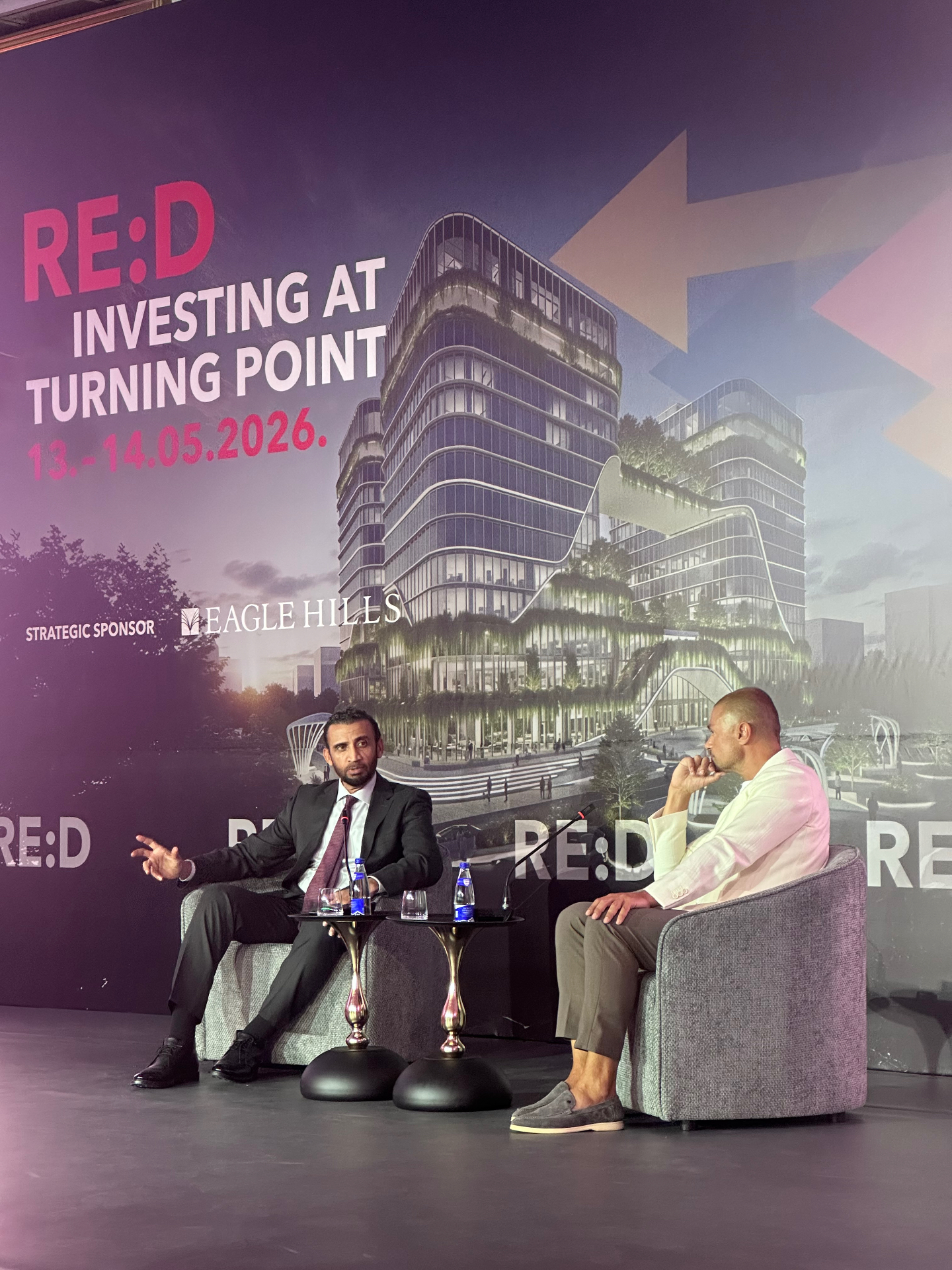
Here is what mattered for anyone tracking the Montenegro market.
1. The money has already decided
If you are waiting for a "clearer signal" to enter the market, you are already late.
Naguib Sawiris (Orascom) built Luštica Bay. H.E. Mohammed Al-Shaibani represents the Investment Corporation of Dubai, which owns Porto Montenegro. Mohamed Alabbar (Emaar/Eagle Hills) announced Eagle Hills' entry into Montenegro at RE:D 2025; at RE:D 2026 he came back with execution - building in Belgrade, introducing Šas Heights overlooking Lake Šas, with Kolašin under review.
None of these names came to Budva to evaluate Montenegro. Sawiris and ICD established their positions years ago. Alabbar announced his entry last year and returned this year with projects already in motion.
If the largest players in the region are reporting on execution, the market has already validated itself. Porto Montenegro's marina has been at 100% occupancy below 35 metres for three years running, with a 100-berth expansion scheduled to begin in 2027.
2. Infrastructure is the real risk
David Margason, Managing Director of Porto Montenegro, gave the most useful frame on the real estate panel -
"Real estate is derived demand. It's derived from people's desire to live somewhere, or visit somewhere, or shop... particularly when you're in pioneering locations."
That principle cuts both ways. A reason to come only translates into yield if people can actually arrive. Connectivity is improving - British Airways now flying to Tivat, Wizz Air expanding in Podgorica - but airport capacity, the absence of night flights, and chronic summer traffic between Tivat and Budva remain unsolved at the public-infrastructure level. The race between private luxury infrastructure and public infrastructure is the defining risk of this market.
Every panel kept coming back to the same point - operators, developers, transport, municipalities. Airport capacity, road infrastructure, summer traffic. That's what's holding the market back.
3. The Sveti Stefan signal
Aman Sveti Stefan is reopening. That is the headline, confirmed from the stage. The more important story underneath is what makes this reopening credible rather than promotional.
Stathis confirmed something concrete about demand: within Aman's global system, Sveti Stefan is now the first destination guests are asking to book. After five years of closure, the brand equity strengthened rather than decayed.
The relaunch sits on top of a working communication task force linking the government, the municipality, Morsko Dobro, the local community, and Aman as operator. After five years of dispute, that structural change is the part that matters.
Stathis described running into former Sveti Stefan staff in country after country over the last five years - Montenegrins now running top hotels and restaurants around the world, all telling him the same thing: they wanted to come back. He's rehiring them now, better trained than when they left.
Two adjacent signals from the same panel matter beyond Sveti Stefan itself. Petros Stathis publicly endorsed Mohamed Alabbar's entry -
"I don't know a single country that doesn't want him to be there. For him to be part of investment in Montenegro is one of the biggest passports in the world."
One major operator confirming another's bet on the same stage. And EU accession was flagged as a real tailwind rather than a slogan.
The asset is back, and the Riviera is on the map again.
4. The coast to mountain corridor
The two operators with the deepest institutional commitments to Montenegro are both moving from south to north.
Stathis is anchoring the north with Hotel Durmitor in Žabljak - a €40 million investment operating under Aman's wellness brand "Janu." Alabbar is going the same way: Šas Heights overlooking Lake Šas is the southern coastal anchor, and Kolašin in the central north is reportedly under active evaluation.
The thesis has shifted from a four-month coastal play to a year-round, coast-to-mountain destination.
This works at scale only if the highway is finished and the airports can handle the volume. The capital is in anyway.
5. Security over incentives
Montenegro maintains a highly competitive 9-15% tax regime, but that alone is no longer enough. Italy and Greece are aggressively updating their codes specifically to attract relocated capital. Petros Stathis put it directly -
"Make them feel secure. Make them feel, let's say, important."
High-net-worth buyers can tolerate high prices. They cannot tolerate uncertainty.
What was obvious across the conference, and rarely said out loud, is that the municipal level and the state level still do not coordinate well. The bureaucracy gap between them is where investor confidence leaks.
The tax advantage does not convert if the legal framework keeps trapping investors in bureaucratic limbo - at every level.
The bottom line
RE:D 2026 confirmed the fundamentals. Sovereign and institutional capital is here and executing. Aman's global demand for Sveti Stefan strengthened during the closure rather than fading. The coast-to-mountain thesis is moving from announcement into construction.
The gap that widened is the one between the marketing premium and the economic reality. The buyers who do well in the next cycle will be the ones who audit the infrastructure, read the road plans, and demand transparency.
For buyers tracking Montenegro property development - RE:D 2026 confirmed where Montenegro real estate capital is moving in the second half of 2026 and beyond.