Buying Property in Belgrade
Ownership rules, the legal process, taxes, closing costs and residency, for foreign buyers in 2026.
Updated
Ana Pajkovic · Licensed Property Specialist · Belgrade & Montenegro
anapajkovic.com · March 2026
At-a-Glance Summary
Foreign Ownership
Allowed (reciprocity-based)
Currency
RSD (dinar), but priced in EUR
Closing Costs (New-Build)
~0.5-1% (+ VAT)
Closing Costs (Resale)
~3-5%
Annual Property Tax
0.1-0.4%
Capital Gains Tax
15% (0% after 10 years)
Rental Income Tax
Effective 15%
Residency via Ownership
Available
Mortgage for Foreigners
Limited - mostly cash
DTT Network
64 countries
Can Foreigners Buy Property in Belgrade?
Yes. Serbia allows foreign citizens and legal entities to purchase property with full ownership rights, provided there is reciprocity with the buyer's home country. Over 75 countries currently qualify, including all EU member states, the United Kingdom, the United States, Canada, the UAE, Australia, and most major investor markets.
Ownership is registered in the national real estate cadastre managed by the Republic Geodetic Authority (RGZ). Once registered, ownership rights are fully protected under Serbian law and enforceable in Serbian courts.
What foreign buyers typically purchase in Belgrade
- Apartments and commercial units
- Urban construction land
- Development property
- Investment real estate
- Agricultural land - company structure required
Agricultural land in Serbia - company structure required
Foreign individuals generally cannot directly own agricultural land in Serbia. If a foreign buyer wants to purchase agricultural land, the property is typically acquired through a Serbian limited-liability company (DOO).
The buyer sets up a local DOO (minimum founding capital 100 RSD, under €1), and the company becomes the legal owner of the land while the buyer owns the company shares. A lawyer handles the formation alongside the property purchase. It takes 5-7 business days through the Agency for Business Registers (APR).
This structure is common for rural land purchases, investment land, and development parcels. However, most apartments, offices, and new-build properties are located on urban construction land, which foreign individuals can own directly. The company structure only becomes relevant when land is officially classified as agricultural in the cadastre.
Entity structures for institutional buyers
Institutional investors and funds typically use the same DOO structure described above to acquire Belgrade property. It limits liability, is more tax-efficient, and is easier to run across several units. Foreign companies can also purchase property directly without a local entity, though the DOO is standard practice for bulk acquisitions.
Is Buying Property in Belgrade Safe?
Belgrade is a safe place to buy when the legal due diligence is done properly. The cadastre records ownership and encumbrances, and every property transaction must be notarized.
Most risks come from incomplete documentation on older properties or unregistered structures, which is why foreign buyers work with a qualified real estate lawyer. According to the Republic Geodetic Authority (Q3 2025), partially regulated transactions accounted for 11% of all purchase contracts in Belgrade, down from 19% the previous year.
Escrow mechanisms exist in Serbia, but there is no mandatory, standardized buyer-protection or bank-guarantee framework comparable to many Western European jurisdictions.
How to Buy Property in Belgrade - Step by Step
Buying in Belgrade is fast compared with most European markets. Once terms are agreed, ownership registration takes a few weeks.
Reservation
The buyer selects a property and signs a reservation agreement or pre-contract (predugovor), paying a deposit to secure the property while due diligence proceeds.
Legal Due Diligence
A lawyer verifies ownership in the cadastre, checks for liens or encumbrances, confirms building permits and approvals, and reviews contract terms. For resale purchases, independent legal review is strongly recommended. For new-build purchases from established developers, contracts are standardized and non-negotiable - an independent lawyer cannot change the terms, though a review can help the buyer understand what they are signing.
Sales and Purchase Agreement (SPA)
The SPA is signed before a notary public. The notary confirms identity, legal understanding, and electronically submits the transaction to the cadastre within 24 hours.
Payment
Payment is made by bank transfer in euros. New-build properties may follow instalment schedules tied to construction milestones (typically 5-10 instalments over the construction period).
Title Registration
For resale properties, ownership is recorded in the cadastre by the RGZ within 5 working days of notary submission. For new-build properties, title registration takes place after the building receives its usage permit (upotrebna dozvola), which is issued upon completion of construction.
How long does it take to buy property in Belgrade?
| Purchase Type | Timeline | Notes |
|---|---|---|
| Resale property | 2-4 weeks | Due diligence 3-7 days, cadastre 5-20 days |
| Completed new-build | 3-6 weeks | Contract prep 3-10 days, cadastre 2-4 weeks |
| Off-plan property | Varies | SPA signed immediately; title after completion |
What can slow down a property purchase in Belgrade
Delays are usually administrative rather than legal: building not yet registered in the cadastre, missing usage permit (upotrebna dozvola), or bank transfer and AML compliance checks. The legal transfer itself is typically quick once documentation is complete.
Can You Buy Property in Belgrade Remotely?
Yes. A foreign buyer can complete a property purchase entirely remotely without visiting Serbia. The buyer grants Power of Attorney (PoA) to a lawyer, who then acts on their behalf throughout the process.
How Power of Attorney works for property purchases in Belgrade
- The PoA can be signed at a Serbian consulate or notarized abroad with an apostille
- The buyer's representative is typically their lawyer
- Under the PoA, the lawyer can sign the purchase agreement, pay taxes, and register ownership
- In some cases, administrative steps may be handled by a real estate agent or developer representative, but legal signing and title registration are usually handled by legal counsel
Tax ID (PIB) and Bank Account for Foreign Buyers in Belgrade
Serbian Tax Identification Number (PIB)
Foreign buyers must obtain a Serbian tax identification number (PIB) before the property purchase can be registered. In most cases, the buyer does not need to apply personally - a lawyer can obtain the PIB on the buyer's behalf using a notarized power of attorney.
How to get a PIB in Serbia
- Lawyer prepares the application
- Buyer provides a passport copy
- Power of attorney is signed
- Lawyer submits the request to the Tax Administration (Poreska uprava)
Timeline: Usually 1-3 business days, sometimes same day.
Opening a Bank Account in Serbia as a Foreign Buyer
A Serbian bank account is not legally required for a cash property purchase. Many foreign buyers complete transactions using international transfers directly to the seller or developer. However, a local account is commonly needed in practice for paying transfer tax and annual property tax, utility payments, residency applications, and managing rental income.
Banks for foreign property buyers in Serbia
| Bank | Notes |
|---|---|
| Banca Intesa | Serbia's largest bank; commonly used for property transactions |
| Raiffeisen Bank Serbia | Strong international banking network |
| UniCredit Bank Serbia | Good for EU-based buyers |
| Erste Bank Serbia | May be stricter on compliance |
Opening a bank account in Serbia is straightforward for property buyers. Banks typically require proof of property purchase, source of funds documentation, and standard identity/compliance checks.
Realistic timeline: PIB in 1-3 days; bank account in a few days to 2 weeks depending on compliance checks.
Property Taxes and Closing Costs in Belgrade
Transaction costs in Belgrade are low compared with most European markets, and they differ a lot between new-build and resale.
Closing costs for new-build property in Belgrade
| Cost Item | Amount | Notes |
|---|---|---|
| Transfer tax | None | No transfer tax on new-build directly from developer |
| VAT (residential) | 10% | Apartments - always quoted as price + VAT |
| VAT (commercial/offices/garages) | 20% | Standard rate for non-residential units |
| Notary & registration | €300-€800 | Identity verification, contract solemnization |
| Translation (if required) | €200-€400 | Contract and cadastre documents |
| Legal fees | €500-€2,000 | Optional - major developers use standardized contracts |
| Agent commission | None | Paid by the developer |
| Total closing costs | ~0.5-1% | Of purchase price (+ VAT on top) |
Closing costs for resale property in Belgrade
| Cost Item | Amount | Notes |
|---|---|---|
| Transfer tax | 2.5% | Legally the seller's obligation, but in practice paid by the buyer |
| VAT | None | No VAT on resale properties |
| Notary fees | ~0.1-0.5% | Of purchase price |
| Legal fees | €500-€2,000 | Due diligence and contract review |
| Agent commission | ~1-2% | Both buyer and seller pay their own agent |
| Total closing costs | ~3-5% | Of purchase price (all-in) |
Ongoing Property Costs in Belgrade
Annual Property Tax in Belgrade
Annual property tax in Belgrade typically ranges from 0.1% to 0.4% of the assessed property value, depending on the municipality and property classification. Tax is calculated annually and paid in four quarterly instalments (February, May, August, November).
Property Insurance in Belgrade
Property insurance is not legally required for cash purchases but is required for mortgages. For a €100,000-€250,000 apartment, typical annual insurance costs are €80-€200, covering fire, water damage, earthquake, and liability.
Monthly Running Costs for Property in Belgrade
Monthly ownership costs are modest compared to Western Europe. The main variable is building maintenance, which differs a lot between new-build managed developments and older non-managed buildings.
Building maintenance charges in Belgrade
New-build developments with managed facilities (lobby, elevator, security, cleaning) charge €1.5-€4/m² per month, depending on the amenities (pool, gym, concierge). For a 70 m² apartment, this means €105-€280/month.
Older, non-managed apartment buildings have very low maintenance costs - typically €10-€15/month depending on the size of the building and the agreement among owners/inhabitants.
Older apartment - non-managed building (60-80 m²)
| Cost Item | Monthly Range |
|---|---|
| Building maintenance | €10-€15 |
| Electricity | €40-€90 |
| Water and garbage | €15-€30 |
| Internet | €15-€25 |
| Property tax (annualized) | €15-€50 |
| Typical total | €80-€210/month |
New-build managed development (70 m²)
| Cost Item | Monthly Range |
|---|---|
| Service charges (€1.5-€4/m²) | €105-€280 |
| Electricity | €50-€100 |
| Internet | ~€20 |
| Water and garbage | €20-€30 |
| Property tax (annualized) | €15-€50 |
| Typical total | €210-€480/month |
Rental Income Tax in Belgrade
Rental income from property in Serbia is taxed at 20% of the taxable base - not on gross rent. Serbia allows a standard 25% cost deduction, which reduces the effective tax rate.
Rental income tax calculation (25% standard cost deduction)
| Amount | |
|---|---|
| Gross annual rent | €10,000 |
| Standard costs (25%) | -€2,500 |
| Taxable base | €7,500 |
| Tax at 20% | €1,500 |
| Effective tax rate on gross rent | 15% |
This rate applies equally to residents and non-residents. Alternatively, landlords can elect to deduct actual documented expenses (maintenance, repairs, mortgage interest) instead of the standardized 25% deduction, if actual costs are higher. Tax returns (form PP OPO) must be filed within 30 days of receiving rental payment.
Capital Gains Tax on Property in Belgrade
Capital gains from selling property in Serbia are taxed at 15% of the gain. Properties held for more than 10 years are exempt entirely.
Double Taxation Treaties - Serbia
Serbia maintains an extensive network of double taxation treaties covering 64 countries, including most major buyer markets. Where a DTT exists, the treaty typically applies a credit or exemption method so the same income is not taxed twice.
Countries with Serbia double taxation treaties
- United Kingdom
- Germany
- France, Italy, Austria, Netherlands, Switzerland, and most EU markets
- UAE, China, Canada, Australia
Regardless of nationality, all buyers should consult a tax advisor in their home country before purchasing to understand their specific cross-border tax position.
Repatriation of Funds from Serbia
Foreign investors can freely repatriate all financial assets related to their property investment without restriction or delay. This includes rental income, sale proceeds, capital gains, and dividends (if held through a DOO). Serbia does not impose exit taxes or forced reinvestment requirements.
Serbia's anticipated integration into the Single Euro Payment Area (SEPA) will further reduce cross-border transaction costs for euro-denominated transfers.
Can Foreigners Get a Mortgage in Belgrade?
Technically yes, but in practice Serbia is still largely a cash market for foreign buyers. According to the Republic Geodetic Authority, 75% of apartment purchases in Q1 2025 were completed in cash, though mortgage-financed transactions rose to 25%, up from previous years.
Several Serbian banks lend to foreign nationals, but usually only if the buyer has residency in Serbia, income in Serbia, or an existing banking relationship. For non-resident international buyers, mortgages are uncommon.
Mortgage terms for foreign buyers in Serbia
| Parameter | Typical Range |
|---|---|
| Loan-to-value (LTV) | 50-70% |
| Interest rate | 5-7% |
| Term | Up to 20 years |
| Currency | EUR |
| Down payment | 30-50% |
| Property requirement | Must be completed and registered |
Eligibility requires proof of stable income, valid health insurance, and residency documentation. Some banks decline US citizens due to FATCA reporting obligations. Terms vary a lot between banks, so speak to the banks directly or use a local mortgage broker.
Developer payment plans in Belgrade
Most new-build developers in Belgrade offer instalment payment plans for off-plan purchases, spread over the construction period (12-36 months). Payment is tied to construction milestones - typically 20% upfront, then 20% at each major milestone, with a final payment upon completion. This effectively provides interest-free financing and is the most common alternative to cash or mortgage for foreign buyers.
How to Get Residency in Belgrade Through Property Ownership
Property ownership in Serbia is a route to temporary residency. There is no minimum investment threshold - any property purchase qualifies. Serbia does not have a Citizenship by Investment (CBI) program.
Serbia residency requirements for property owners
- Proof of property ownership (registered in cadastre)
- Health insurance valid in Serbia
- Background check / police clearance
- Local address registration
Health insurance for Serbia residency - what counts?
You must submit proof of health insurance as part of the residency application. In practice, what is typically accepted:
- A private policy that is valid in Serbia (often arranged locally)
- An international/private policy, provided it explicitly covers Serbia and includes emergency care and hospitalization
Health insurance costs for Serbia residency
| Coverage Type | Annual Cost (per adult) |
|---|---|
| Local/basic private cover | ~€200-€500 |
| International expat-style cover | ~€500-€1,500+ |
Can family members get Serbia residency through property?
Yes - spouse and children can obtain residency through family reunification once the main applicant has temporary residence.
How long does the Serbia residency application take?
In practice, expect 4-8 weeks, with delays possible if documents, translations, or apostilles are incomplete.
Pathway to permanent residency and Serbian citizenship
Temporary residency permits are valid for up to 3 years and are renewable. After 3 years of continuous temporary residency, holders may apply for permanent residency. Serbian citizenship may be available after approximately 6 years of continuous residence.
Where to Buy Property in Belgrade
Foreign buyers concentrate in a handful of central municipalities.
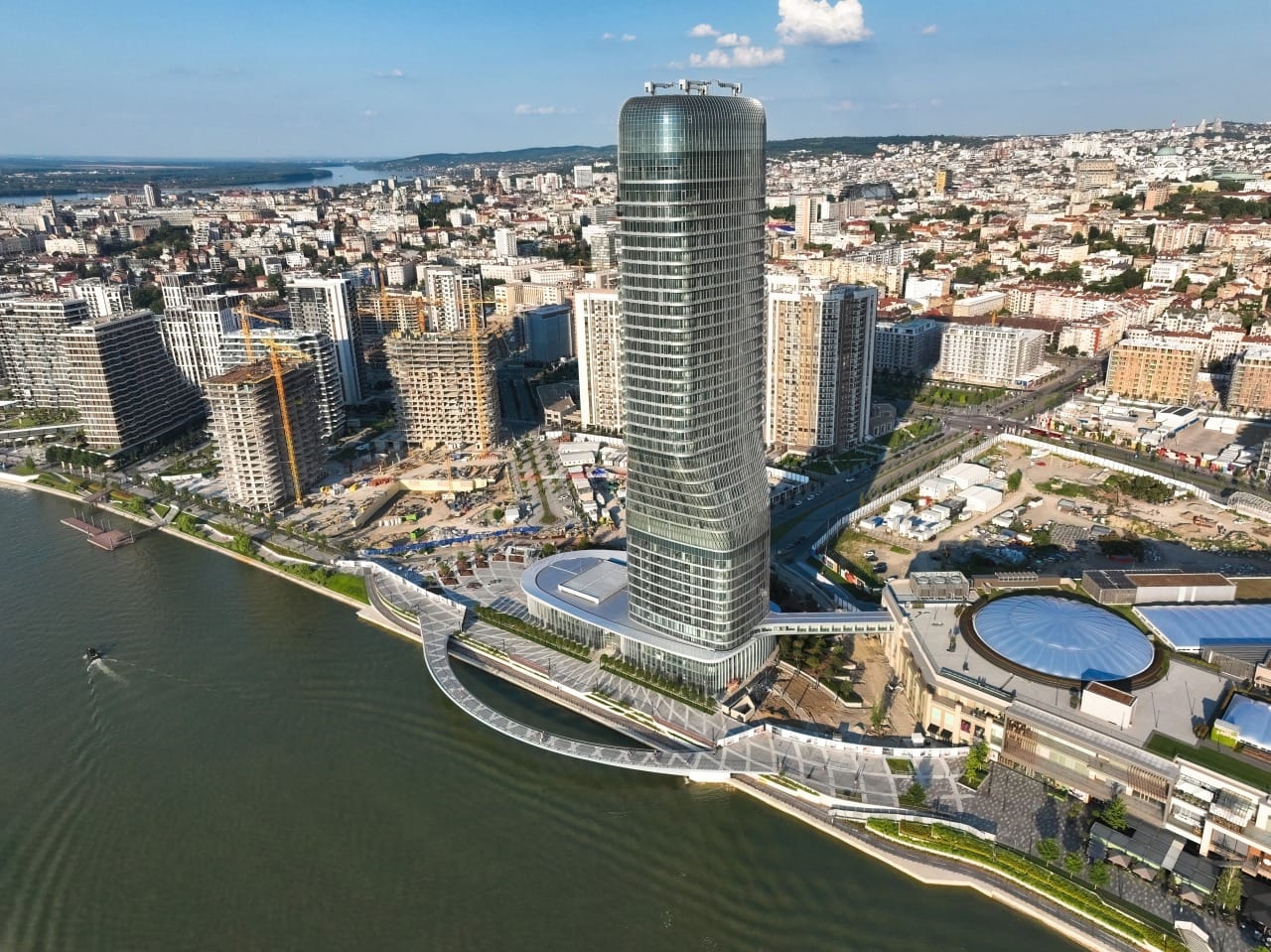
Belgrade Waterfront (Savski Venac) - A mixed-use development along the Sava riverbank. Premium pricing (€4,500-€6,800+/m²), and the most liquid segment for resale.
Marina Dorćol (Stari Grad / Dorćol) - A major Danube riverbank development featuring 564 apartments. Dorćol's heritage character and its walking distance to the centre keep demand steady.
Danube Riverside (New Belgrade) - A mixed-use complex on the site of former Hotel Jugoslavija, featuring a luxury hotel and two high-rise residential towers with 410 apartments.
Delta District (New Belgrade, Block 20) - A premium mixed-use complex by Delta Real Estate featuring two residential towers (26 and 13 floors), connected to the InterContinental Belgrade hotel. Amenities include a spa, rooftop pool, concierge and private gym. The developer says it is the first WELL and LEED certified residential complex in the region. Completion expected 2027.
Vračar - Belgrade's most established premium residential neighbourhood. Dense, with little new supply, and it rents well to professionals and diplomats.
New Belgrade - The city's commercial hub with massive ongoing development. Projects like Wellport, Soul 64, and the ABL Solvent Green Line (5,000 apartments across six blocks) are reshaping the landscape. Rental demand comes from the corporate tenant base.
Real Estate Agent Fees in Belgrade
Real estate commission in Belgrade runs at about 1-2% of the property value. Both buyer and seller pay their own agent. In new-build developments, the developer covers the agent's commission - buyers do not pay agent fees when purchasing new-build property.
For institutional or bulk purchases (5+ units), commission is negotiated directly with the agent and developer, usually at a reduced rate.
Frequently Asked Questions About Buying Property in Belgrade
Before you buy
Ownership rights are clear, transaction costs are low and the legal process is well defined. Two questions change your numbers more than anything else on this page: whether the building is already registered in the cadastre, and whether you are buying new-build (VAT on top, no transfer tax) or resale (2.5% transfer tax, no VAT). Settle both before you pay a deposit.
Related Guides

'%3e%3crect%20x='0'%20y='0'%20width='80'%20height='120'%20fill='%23C6363C'%20stroke='%23F4D03F'%20stroke-width='4'/%3e%3cline%20x1='40'%20y1='0'%20x2='40'%20y2='120'%20stroke='%23F4D03F'%20stroke-width='3'/%3e%3cline%20x1='0'%20y1='40'%20x2='80'%20y2='40'%20stroke='%23F4D03F'%20stroke-width='3'/%3e%3cline%20x1='0'%20y1='80'%20x2='80'%20y2='80'%20stroke='%23F4D03F'%20stroke-width='3'/%3e%3cpolygon%20points='40,-30%2030,-10%2050,-10'%20fill='%23F4D03F'/%3e%3cpolygon%20points='20,-25%2015,-10%2025,-10'%20fill='%23F4D03F'/%3e%3cpolygon%20points='60,-25%2055,-10%2065,-10'%20fill='%23F4D03F'/%3e%3c/g%3e%3c/svg%3e)
Belgrade Waterfront: Which Building?
Belgrade · Serbia · Building Guide
All Belgrade Waterfront residential towers compared - new-build, resale and upcoming. Prices, unit mixes and a quick matcher to shortlist.
10 min read

%20--%3e%3cg%20transform='translate(450,%20300)'%3e%3c!--%20Left%20head%20--%3e%3ccircle%20cx='-40'%20cy='-20'%20r='18'%20fill='%23F4D03F'/%3e%3cpolygon%20points='-50,-20%20-65,-15%20-65,-25'%20fill='%23F4D03F'/%3e%3c!--%20Right%20head%20--%3e%3ccircle%20cx='40'%20cy='-20'%20r='18'%20fill='%23F4D03F'/%3e%3cpolygon%20points='50,-20%2065,-15%2065,-25'%20fill='%23F4D03F'/%3e%3c!--%20Body%20--%3e%3cellipse%20cx='0'%20cy='10'%20rx='35'%20ry='45'%20fill='%23F4D03F'/%3e%3c!--%20Wings%20--%3e%3cpath%20d='M%20-30%205%20Q%20-60%200%20-70%2020'%20stroke='%23F4D03F'%20stroke-width='8'%20fill='none'/%3e%3cpath%20d='M%2030%205%20Q%2060%200%2070%2020'%20stroke='%23F4D03F'%20stroke-width='8'%20fill='none'/%3e%3c/g%3e%3c/svg%3e)
Buying Property in Montenegro
Montenegro · Country Guide
Legal process, taxes, residency, and closing costs for foreign buyers.
10 min read
Buying Property in Montenegro as an American
Montenegro · US Buyer Guide
Residency, costs, healthcare and where to live in Montenegro for US buyers in 2026.
10 min read
Thinking about buying in Belgrade?
Get the Belgrade Buyer's Starter Pack.
Foreign ownership rules · Closing costs & taxes · Buying timeline · New build vs resale
Prefer to talk? Message me on WhatsApp.
This guide was written by Ana Pajkovic, a licensed property specialist covering prime properties in Belgrade and Montenegro. Last updated: September 2026.
anapajkovic.com
This guide is for informational purposes only and does not constitute financial or legal advice.
Have questions?