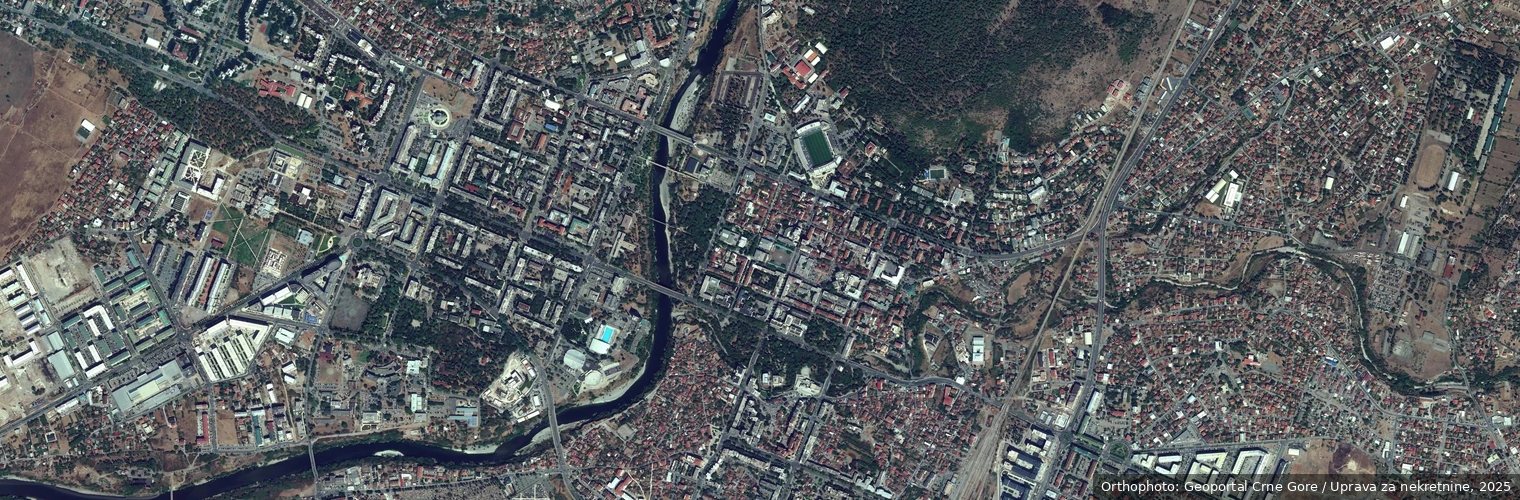
Verify a Podgorica parcel before you buy
Run a Montenegro cadastre check to verify property ownership, encumbrances, zoning and protection zones. Enter a parcel number and get an instant, plain-language report:
Want help reading the result? Ask Ana →
Five things to know before you buy land in Podgorica
- Over 1,200 land plots are listed in the Podgorica area - the widest range in the country. It runs in three tiers: central, urbanised plots around €300-€620/m² (e.g. Gorica C, Dalmatinska ulica), ordinary city-edge buildable €80-€130/m², and agricultural outskirts €10-€30/m².
- Cheap per m² is the warning sign, not the deal. The €10-€30/m² fields are mostly poljoprivredno (agricultural) land with no building rights - while the prime plots near the centre are urbanised and permit-ready, which is exactly why they cost 20-40× more per m².
- Building rights come from the plan, not the listing. What you can build is set by the binding plan for that parcel - often a local DUP/PUP, not the national plan - and confirmed per plot by the UTU / izvod iz plana, a manual check at the municipality. See how Montenegro's plans work →
- Inland risks are different from the coast: river flood zones (Morača, Zeta, Cijevna), the Ćemovsko polje water-source zone, airport-area limits to the south, and the Skadar Lake park fringe.
- Asking ≠ selling here more than anywhere. Podgorica has Montenegro's widest gap between ask and actual price - verify the parcel, then offer accordingly.

Send me the parcel number
I'll tell you:
- ✓ Can you build on it?
- ✓ Is it building land or agricultural?
- ✓ Anything unusual in the title?
- ✓ What I'd worry about if I were buying it.
Just the parcel number to start - Ana will confirm the cadastral municipality (KO) with you. Independent · no buyer commission in Montenegro, no obligation.
Podgorica is the one Montenegrin market where you buy land mainly to build a house or develop, not for a sea view. It's the capital - year-round economy, the country's largest population, the deepest rental market - and it has more land on the market than the entire coast combined. That depth is the opportunity and the trap: plenty of genuine building plots near the city, surrounded by a much larger pool of agricultural fields priced to look irresistible.
The Podgorica land ladder - three different assets
In Podgorica, the first question isn't price, it's land category and location. "Land" here spans three genuinely different markets:
Central & established (€300-€620/m²). Urbanised, permit-ready plots in established central pockets - Gorica C and the prestige Dalmatinska ulica strip. Scarce, and priced like it; a 500-800 m² plot here runs €220,000-€460,000. This is where serious house-builders and developers compete. One caveat: a high €/m² alone doesn't make a plot central, or its asking price the market - a small urbanised plot in a peripheral area can post the same number, so check the location and treat the figure as an ask, not a sale.
City-edge buildable (€80-€130/m²). Plots in and around Gornja/Donja Gorica, Masline and Dajbabe - inside or next to the building zone but further out. Where most family-home plots actually trade.
Agricultural outskirts (€10-€30/m²). The Kuči hills, the Zeta valley, the far edges. Poljoprivredno land - you can own it, but a building permit is a different, often impossible, conversation. The cheap per-m² number is the tell.
Same word "land," three completely different assets. Most buyer mistakes here come from comparing a price in one tier against a plot in another.
What you can build
What you can build is decided at two levels. The state plans - PPCG 2040 and the country-wide PGRCG - set the broad zone and land use. The binding parameters for a specific plot (zone, building index, permitted floors) come from the UTU (urbanističko-tehnički uslovi) / izvod iz plana, which usually draws on a still-valid local plan - a DUP, GUP, PUP, DSL or LSL - or a PPPN for special areas such as the Skadar Lake park. The plan's name doesn't give you the parameters; the UTU does, and there's no automatic lookup - it's confirmed at the municipality, parcel by parcel. Treat any spratnost or index in a sales listing as marketing until the UTU confirms it. See how Montenegro's plans - PPCG, DUP, DSL, UTU and the rest - actually work →
Protection & constraint zones to watch
Podgorica's constraints are inland, not coastal: river flood zones along the Morača, Zeta and Cijevna; the Ćemovsko polje water-source protection zone that feeds the city's wells; airport-area height and use limits south toward Golubovci; and the Skadar Lake National Park fringe where the municipality reaches the lake. Any of these can sit on an ordinary-looking parcel - which is what the report flags.
Where land trades in Podgorica
Five live plots show the full ladder, top to bottom:
€617/m²
€300/m²
€206/m²
€124/m²
€20/m²
Live examples from our Montenegro listings tracker, June 2026. Asking prices.
The cheapest land in Podgorica is cheap for a reason you can't fix.
A €20/m² field outside town isn't a bargain version of a €120/m² building plot - it's a different category, and no amount of negotiating turns farmland into a permit. Buyers chase the per-m² number and end up owning land they can't build on. Confirm the parcel's category and UTU first; the price only means something after that.
House-builders after a central, permit-ready plot (Gorica C, Dalmatinska), family buyers on a verified city-edge plot (Gornja/Donja Gorica, Tološi, Dajbabe), and developers wanting year-round capital-city demand over seasonal coastal resale.
Agricultural land sold as "investment," flood-zone parcels by the rivers, missing utility/road access on outskirt plots, and Podgorica's unusually wide asking-vs-selling gap.
Before you buy land in Podgorica
Don't rely on:
- Listing descriptions
- Agent claims
- Seller statements
Verify the parcel first - ownership, land category, zoning, protection regime, and what you can actually build.
Common questions
Can foreigners buy land in Podgorica?
Yes - foreign individuals can buy property in Montenegro, including in Podgorica. Agricultural land is the key exception: foreigners usually hold farm land through a Montenegrin company rather than personally, and much of Podgorica's cheap outskirt land is agricultural. Confirm the specific parcel before committing.
How much does land cost in Podgorica?
As of June 2026, central and established plots ask around €300-€620/m², ordinary city-edge buildable plots €80-€130/m², and agricultural land on the outskirts just €10-€30/m². Small plots start near €23,000. All are asking prices, not confirmed sales.
Why is some Podgorica land so cheap (€10-€30/m²)?
Because it is agricultural (poljoprivredno) land, which usually carries no building rights. You can own it, but you generally cannot build on it - so a very low price per m² is a warning sign, not a bargain.
How do I know a Podgorica plot is buildable?
Two checks: the land category (građevinsko vs poljoprivredno) and the binding plan for that parcel - often a local DUP or PUP - confirmed by the UTU / izvod iz plana at the municipality. A listing's "urbanizovan" claim is not proof until the UTU confirms it.
Which Podgorica areas are central or prime?
Genuinely central or established pockets include Gorica C, the Dalmatinska ulica strip and the Preko Morače business district (Capital Plaza, City Kvart, Master Kvart). Tološi, Zabjelo and the Gorica edges are outer/city-edge; Konik is peripheral; Kuči and the Zeta valley are rural. A high price per m² alone does not make an area prime.
Related land guides
- Buying Land in Tivat →
- Buying Land in Budva →
- Buying Land in Herceg Novi →
- Buying Land in Kolašin →
- Montenegro Planning Documents Explained →
See also: All buyer guides · Ask Ana